Category: K-ECONOMY

  • Daiso Expands Cash-Free Retail in Response to Consumer Trends

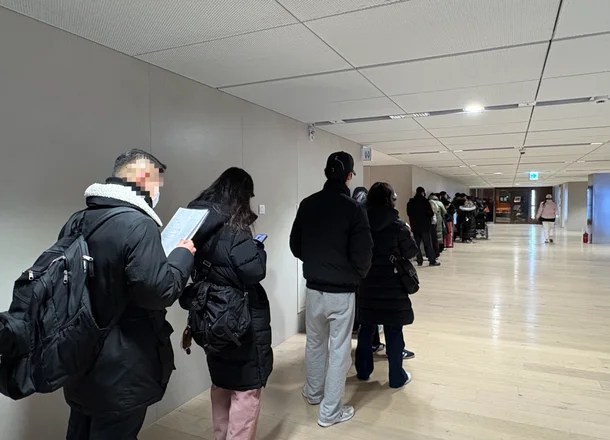
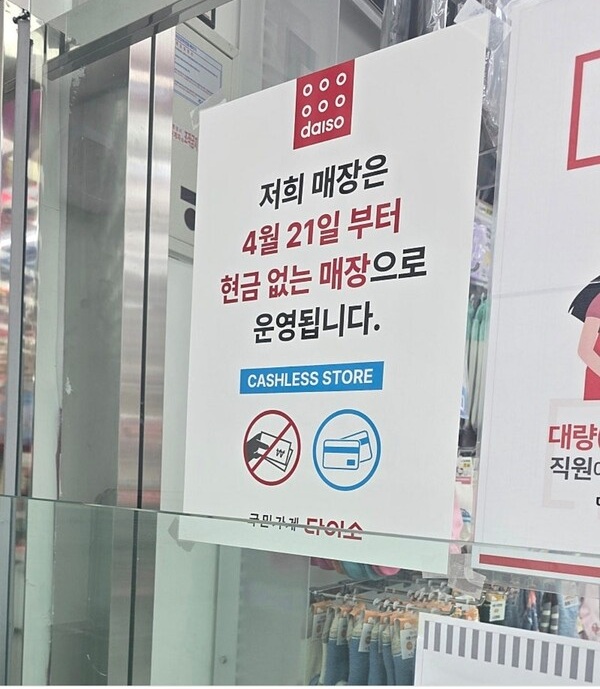
    Daiso has begun piloting a “cashless store” in the Ulsan region as part of its response to shifting consumer trends.

    The pilot location fully blocks cash payments and operates exclusively with card and mobile payment methods. This initiative is widely seen as a strategy to enhance efficiency amid the rapid spread of digital payments and the broader shift toward a cashless society.

    According to a Bank of Korea survey, cash usage among Korean consumers has fallen to 15.9 percent, half the level from a decade ago. As a result, retailers are expanding unmanned checkout systems and automated payment processes to improve turnover and reduce the operational burden associated with handling cash. Daiso also expects faster payment processing and reduced staff workload, and major supermarket chains are likewise adopting card-only unmanned checkouts.

    However, not all age groups can adapt equally to this change. Elderly shoppers and teenagers without easy access to payment cards risk being left out of the new system, raising concerns about accessibility in a fully cashless transition.

    Even so, as mobile payments continue to dominate daily transactions, the number of cashless stores is expected to grow steadily across the country.

  • iPhone Pocket Criticized for High Price and Lack of Functionality

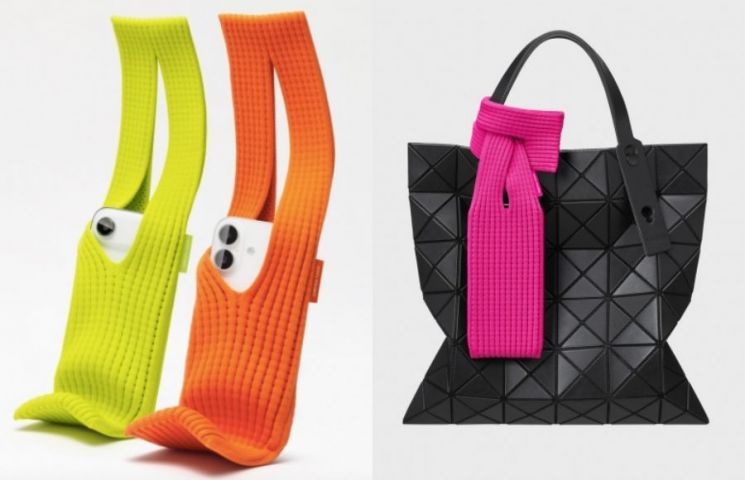
    Apple’s limited-edition accessory, the “iPhone Pocket,” created in collaboration with Japanese designer Issey Miyake, has received widespread criticism worldwide.

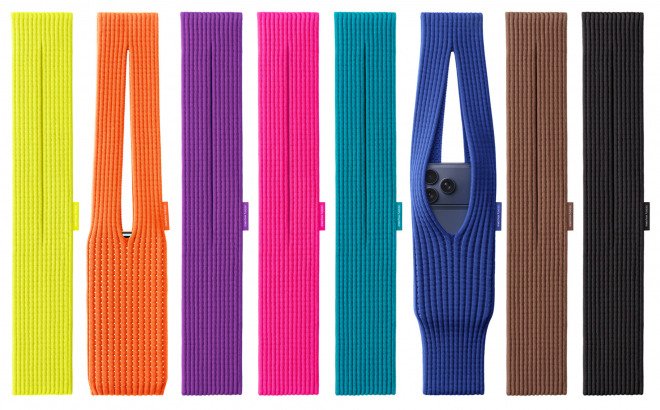
    The product is a minimalist pouch accessory designed to hold an iPhone and other small essentials. It can be worn as a wrist strap, crossbody bag, or attached to another bag. Apple has marketed it as “the most beautiful way to carry your iPhone,” emphasizing its craftsmanship and design by Issey Miyake.

    However, the price and practicality have become major points of contention. The short strap version is priced at $149.95 (around 22,000 KRW), and the long strap version is $229.95 (around 34,000 KRW), which has sparked negative reactions.

    On social media in Korea, users have criticized the product with comments like “A piece of fabric costing over $200,” “It looks completely impractical,” “I could probably find this at Daiso for 2000 KRW,” and “I’d rather just put my phone in my pocket than spend 300,000 KRW on that.”

    Social media consultant Matt Navarra told BBC, “Apple has focused its pricing strategy on form, branding, and exclusivity rather than functionality,” adding, “While this strategy is common in collaborations with luxury brands and designers, most consumers feel that Apple is testing the limits of brand loyalty.”

  • Korea’s “Young Forty” Becomes a Target of Online Mockery

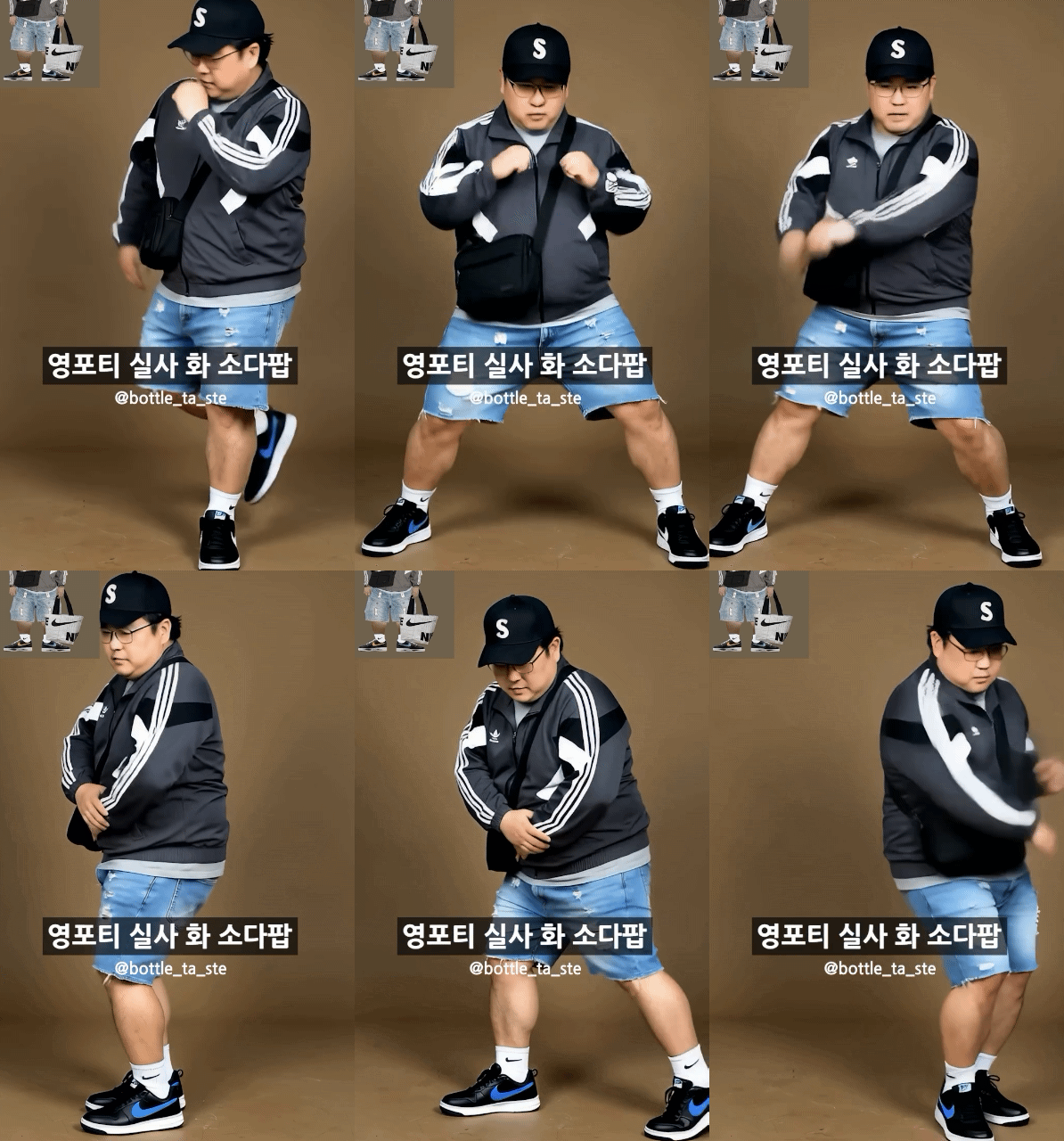
    Once celebrated in the mid-2010s as a declaration of “I’m still young,” the term “Young Forty” represented a generation of 40-somethings who embraced change and enjoyed trends. Seen as leaders in fashion, beauty, and wellness, they became a key consumer group for brands promoting messages like “style has no age.” The phrase “Young Forty look” became popular, symbolizing the idea that age was just a number.

    But recently, that positive image has turned sour.

    Internet memes like “Sweet Young Forty” have transformed the term into an object of ridicule. What once meant “middle-aged with a youthful spirit” now implies “someone desperately trying to look young.” Social media is flooded with parody content such as “acting young challenges” and “Young Forty fashion,” turning youth into a dividing line between generations. According to a CBS survey, 68.3% of respondents in their 20s and 30s viewed “Young Forty” negatively, and 75% first encountered the term through social media memes.

    This shift in perception has impacted the market as well. Brands that once marketed sneakers or luxury goods with “Young Forty appeal” now find themselves outdated in the eyes of younger consumers, leading to disengagement from that demographic.

    Experts interpret this phenomenon as a reflection of generational anxiety and identity competition. Professor Shim Jae-man of Korea University explained, “Younger generations are using humor to reinforce their youth by caricaturing middle age.” Professor Park Jung-min of the Korea National Open University added, “Some showy cases have been generalized to an entire generation, creating stigma. When memes are consumed as mere entertainment rather than social insight, they can deepen generational misunderstanding.”

  • From Luxury to Everyday — The Rise of Unmanned Flower Shops

    Unmanned flower shops are becoming one of Korea’s latest lifestyle trends — offering a convenient and comfortable way for anyone to buy flowers.

    Beyond reducing labor costs and enabling 24-hour operation, these shops have created a welcoming space where men can purchase flowers without hesitation. Traditional flower shops required on-site florists and higher operational costs, but automation has changed the landscape, making flower buying more accessible and affordable.

    The rise of male customers is particularly noteworthy. In a quiet, private space, men can choose flowers freely without feeling self-conscious. Ready-made bouquets, available through vending-style displays, lower psychological barriers and encourage spontaneous purchases. More men are now buying flowers for themselves or as small daily gifts — moving away from the old belief that “flowers are only for special occasions.”

    A prime example is Erfleur, an unmanned flower shop in Suwon, which embodies this new wave. With the slogan “Flowers, closer and more natural”, Erfleur combines a French-inspired interior with reasonable prices. Open from 7 AM to midnight, it restocks fresh flowers three times a week. Owner Seo Subin said, “I wanted to create a space where anyone can buy flowers, even late at night — especially a place where men can feel comfortable choosing them.”

    Unmanned flower shops are now evolving beyond convenience — becoming cultural spaces that represent emotional consumption and gender-neutral lifestyles in modern Korea.

  • Trend Korea 2026: Balancing Technology and Humanity

    Since 2008, Seoul National University Professor Emeritus Kim Nan-do, Korea’s leading consumer trend researcher and author of the annual Trend Korea series, has forecast the year’s consumer patterns. For 2026, he identified “AI” and “humanity” as the defining keywords.

    The report highlights ten key terms: Human-in-the-Loop, Philconomy, Zero-Click, Ready-Core, AX Organization, Pixel Life, Price Decoding, Health Quotient (HQ), 1.5 Households, and Fundamentalism. Some reflect the growing influence of AI, while others emphasize emotion, tradition, and essential values.

    In particular, while AI dominates every sector, keywords such as “Zero-Click” and “AX Organization” demonstrate its direct technological impact. Meanwhile, “Philconomy” and “Fundamentalism” represent a trend toward prioritizing human-centered and fundamental values.

    Professor Kim stressed that “as AI advances, human involvement, emotion, and traditional values become increasingly important,” emphasizing that 2026 will be a consumer era where technology and humanity coexist.